The Short Answer
Kind of. But probably not the way you think.
If you’re here because your goat just ate angel’s trumpet and you’re panicking, take a breath. I’ll give you the practical steps first, then we’ll talk about why the internet has this one mostly wrong.

If your goat grabbed a leaf or two while browsing: Monitor. Watch for staggering, dilated pupils, or rapid breathing over the next few hours. You’re most likely fine.
If your goat sat down and ate several good bites: Give a dose of activated charcoal, then monitor. If symptoms show up, call your vet.
Okay. Now let’s talk about what’s actually going on here.
What the Internet Will Tell You
Google “angel’s trumpet toxic” and you’ll get page after page of terrifying results. Deadly. Poisonous. Hallucinogenic. Do not touch.
And honestly? I almost went down that road too.
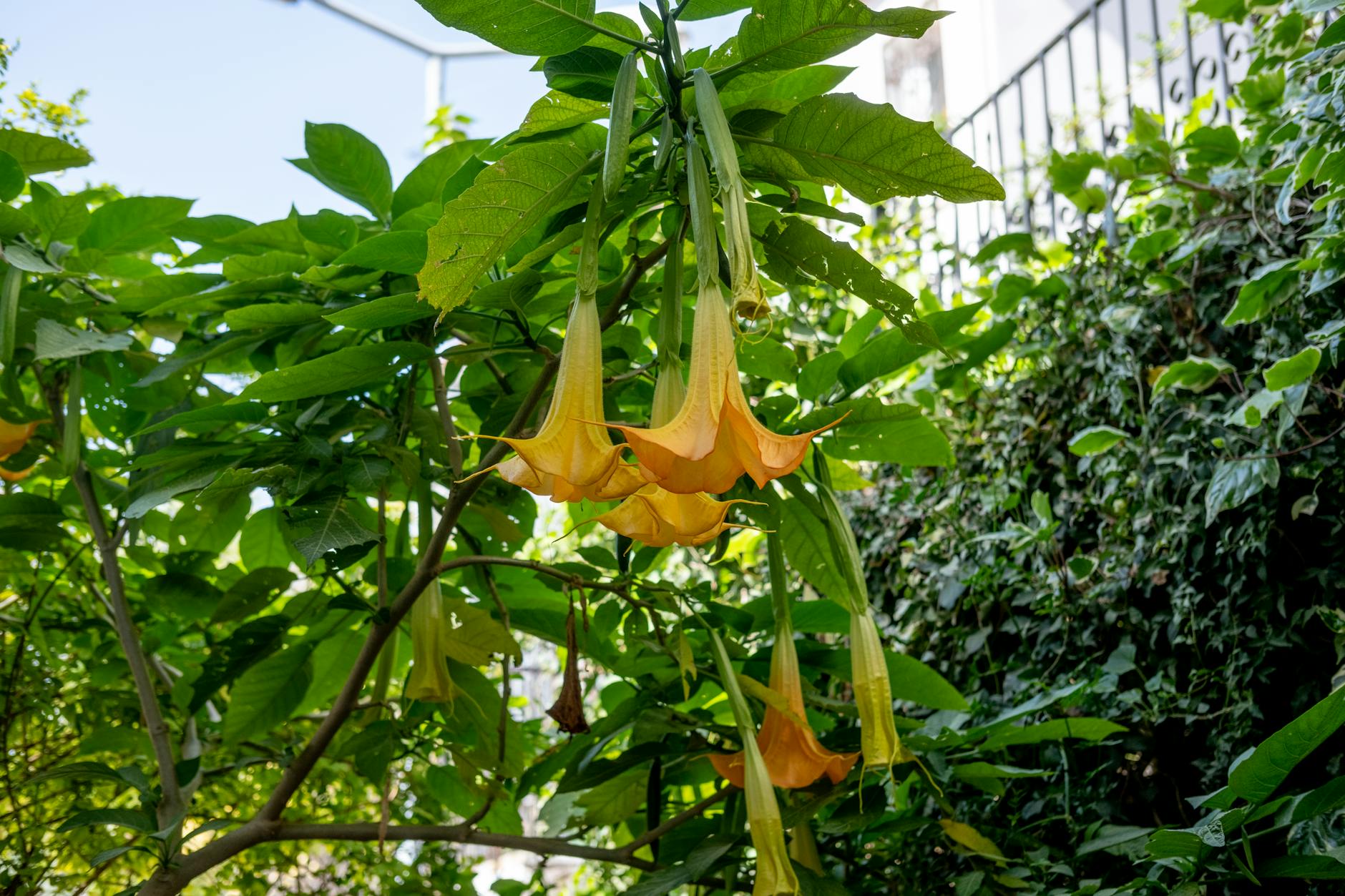
I’m building a comprehensive plant identification database for goat owners. Over 130 plants, each one researched, categorized, and turned into a quick-reference card. When I got to angel’s trumpet (Brugmansia spp.), I did what I always do: I pulled the research.
The studies were alarming. Tropane alkaloids. Atropine and scopolamine. Anticholinergic poisoning. Seizures. Coma. Death.
I was about to slap a big red “Act Now” emergency label on this one and move on.
Then I found a photo that stopped me.
The Image That Changed Everything
It was a stock photo of a man, somewhere that looked like it might be India or Southeast Asia, hand-feeding datura leaves to his goats, and datura is angel’s trumpet’s closest relative, sharing the same tropane alkaloids. If the goats are fine with datura, the concern about angel’s trumpet starts looking a lot less alarming.
Feeding datura is customary where he lives.
All our research screams, “THIS IS GOING TO KILL YOUR GOAT!!!” and here’s this guy casually glancing at the camera while being mobbed by goats munching away.
That’s the moment I realized I needed to dig deeper. Because there’s a pattern I keep seeing in the goat world, and it goes like this: something is documented as toxic in humans, so it gets labeled as toxic for all animals, and nobody bothers to check whether goats specifically are actually at risk.
Goats happen to be one of the most resilient animals when it comes to eating weird things. The “goats will eat anything” trope is completely untrue; they’re extremely picky, taking a tiny nibble and waiting for biofeedback, and that’s why, with few exceptions, they can be mostly trusted to self-select.
What the Goat-Specific Evidence Actually Says
I found an Australian veterinary livestock reference that rates Brugmansia as “low risk to goats.”
Low. Risk.
The same reference notes that angel’s trumpet is “occasionally eaten” by goats, and that poisoning episodes tend to be “restricted to the accidental ingestion of large amounts of seeds, when present as contaminants in other fodder.”
Not from browsing the plant. From contaminated feed. And even then, it’s rare.
Here’s the thing: angel’s trumpet does contain real toxins. Atropine and scopolamine are no joke. But the vast majority of the scary literature is based on human poisoning cases, people intentionally consuming flowers or brewing leaf tea for the hallucinogenic effects.
That’s a very different scenario than a goat nibbling a leaf on a morning walk.
Why This Keeps Happening
This is not the first plant I’ve had to reclassify after actually looking at the evidence. And it won’t be the last.
The goat world has inherited a lot of fear from the broader livestock and human toxicology world. A plant gets documented as poisonous in one context, and it becomes “deadly for goats” in every Facebook group and blog post, with no one checking the actual risk to the actual animal.
I’m not saying we should be cavalier. Angel’s trumpet has real alkaloids, and I wouldn’t suggest you let a goat sit in a garden full of it. But there is a wide, wide gap between “contains toxic compounds” and “will kill your goat if it takes a bite.”
Most of the time, the truth lives in that gap. And your goats are a lot more resilient than the internet gives them credit for.
What I’d Suggest
Honestly? If one of my goats ate angel’s trumpet, I wouldn’t lose sleep over it. But I know not everyone is at that place yet, and that’s okay. So here’s what I’d suggest based on what the evidence actually tells us:
A leaf or two on a walk? Don’t panic. Just watch. You’re almost certainly fine.
A few solid bites? This is a good time to reach for the activated charcoal. One dose, by weight, to bind anything in the gut. Then monitor for staggering, dilated pupils, or rapid breathing over the next few hours.
Symptoms showing up? Call your vet. That’s always the right call when something doesn’t look right.
The point isn’t to be reckless. It’s to be proportional. Context matters. Amount matters. And goats are not humans.
The Bigger Picture
I started building these plant ID cards because I was tired of the fear. Tired of watching people in Facebook groups panic because their goat looked at a plant sideways. Tired of seeing the same recycled “toxic plant lists” that don’t differentiate between “will absolutely kill your goat” and “might cause a stomachache if they eat a pound of it.”
Every plant in my database gets the same treatment: What does the research actually say? What does it say about goats specifically? What’s the real-world risk, not the theoretical worst case?
Some plants genuinely warrant a red alert. But a lot of them, more than you’d think, turn out to have more nuance than the literature suggests.
Angel’s trumpet is one of those.
Want This for Every Plant?
I’m building a complete plant identification system inside Barn Buddy with over 130 plants researched, categorized by real risk level, and formatted into quick-reference cards you can pull up on your phone while you’re standing in the pasture.
Every card includes identification tips, look-alikes, what to actually do, goat-specific notes, and when available, the research behind the rating.
Check it out! *proudly shows you her new shiny art project*
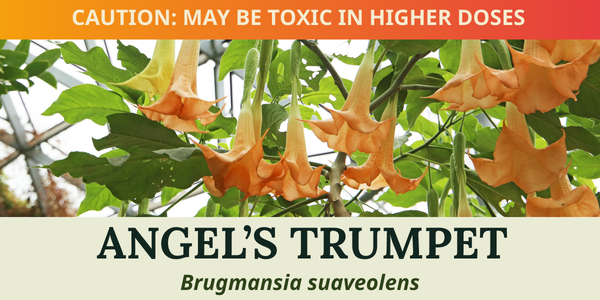
Angel’s Trumpet
- Staggering gait or recumbency (lying down, unable to rise)
- Dilated pupils
- Rapid respiration
- Disorientation or agitation
- GI upset (gastroenteritis)
- Excessive thirst
- Contains tropane alkaloids — atropine and scopolamine
- Rated low risk to goats in veterinary livestock references
- Goats occasionally eat it — not highly palatable but it happens
- Real risk is large quantities of seeds contaminating fodder, not casual browsing
- Related to jimsonweed/datura — same class of alkaloids
- All parts contain alkaloids — flowers, seeds, nectar, leaves, bark
- Don’t feed clippings to livestock — dispose carefully or burn (smoke can be toxic)
- Common ornamental garden plant — originally from Chile and Colombia
- Found year-round in Southeast, Southwest, and Pacific Coast regions
📚 Why We Know This – Research Evidence
If you want more like this, along with dozens of resource cards on specific health conditions and their remedies, herb profiles, my personal herbal blend recipes and a growing collection of plant ID cards like this, it’s all included in Pioneers, an app and community where you can learn through self-paced courses, regular challenges, live chats and Barn Buddy, an AI powered chatbot trained on these cards to help you get fast info on the go. Check out Pioneers here.